
Introduction

Healthcare faces a critical juncture. Regulatory demands are increasing, digital health adoption is accelerating, and the gap between clinical workforce supply and demand is widening. Deficiencies in compliance training and leadership development are reducing the quality of care, limiting team performance, and threatening accreditation for hospitals, clinics, and pharmaceutical networks globally.
Organizations that prioritize workforce enablement as a strategic initiative are advancing in accreditation readiness, patient safety, and operational resilience. By mastering compliance and developing leadership, they gain advantages in attracting talent, retaining patients, and strengthening their market position.
This playbook offers healthcare leaders a practical approach, including the 4-Phase Clinical Mastery Framework, the 6 Essential Healthcare Leadership Domains, and effective scaling matrices for multi-jurisdiction compliance. Whether you develop solutions internally, collaborate with specialists, or combine both, the frameworks and assessment tools will help you address gaps and advance your organization’s success.
Key Insight: Organizations that implement structured clinical mastery frameworks achieve 96% compliance completion, avoid over $900,000 in penalties, and realize a 42-fold ROI within 18 months. In contrast, those using fragmented training experience 58% CPD incompletion and repeated audit failures, which negatively affect patient trust and reimbursement.
The Hidden Gaps Undermining Healthcare Excellence
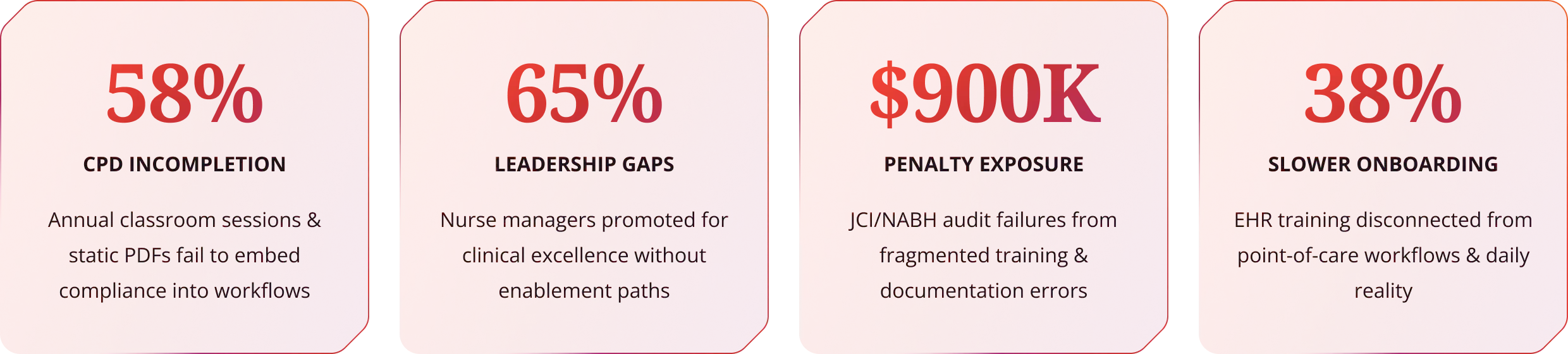
While the statistics are clear, the underlying issue is often overlooked. Healthcare organizations do not fail due to poor clinical intent; they fail because workforce enablement systems are not built to handle the speed, complexity, and scale of current healthcare regulations and digital transformation.
The 58% CPD Incompletion Crisis
Continuing Professional Development (CPD) is essential for accreditation and patient safety. However, 58% of clinicians across hospitals, clinics, and pharmaceutical networks do not complete the required CPD modules. This is not due to a lack of interest, but to structural shortcomings. Traditional classroom sessions, static manuals, and generic e-learning modules fail to integrate regulatory requirements into daily workflows. This leads to fragmented knowledge, documentation errors, and increased risk of penalties under JCI, NABH, and CQC mandates.
The 65% Leadership Gap
Nurse managers, clinical leads, and quality officers form the operational core of healthcare organizations. Yet 65% of healthcare enterprises report leadership gaps that delay promotions and leave key roles vacant. When inexperienced managers oversee accreditation audits, incident investigations, and care coordination, patient outcomes decline. The issue is not a lack of talent, but inadequate enablement pathways.

Digital Transformation Without Digital Readiness
EHR rollouts, telehealth integration, and data security requirements require teams skilled in digital adoption, interoperability, and incident response. However, frontline staff often resist new systems when training is not aligned with daily workflows. This results in 38% slower onboarding, documentation errors that lead to audit findings, and gaps in care quality that affect patient safety and efficiency.
The Patient Trust Deficit
Fragmented workforce enablement erodes patient trust, lowers HCAHPS scores, and reduces reimbursement rates. Competitive positioning also suffers in a consumer-driven healthcare market. Successful organizations understand that workforce training is not a cost center, but the foundation for patient-centered growth.
The 4-Phase Clinical Mastery Framework
The Clinical Mastery Framework is a four-phase methodology for optimizing compliance programs. Proven in over 40 high-stakes clinical deployments, it achieves 96% completion, 68% administrative reduction, and 42x ROI when applied consistently. The framework can be tailored to your organization’s size, regulatory context, and digital maturity.
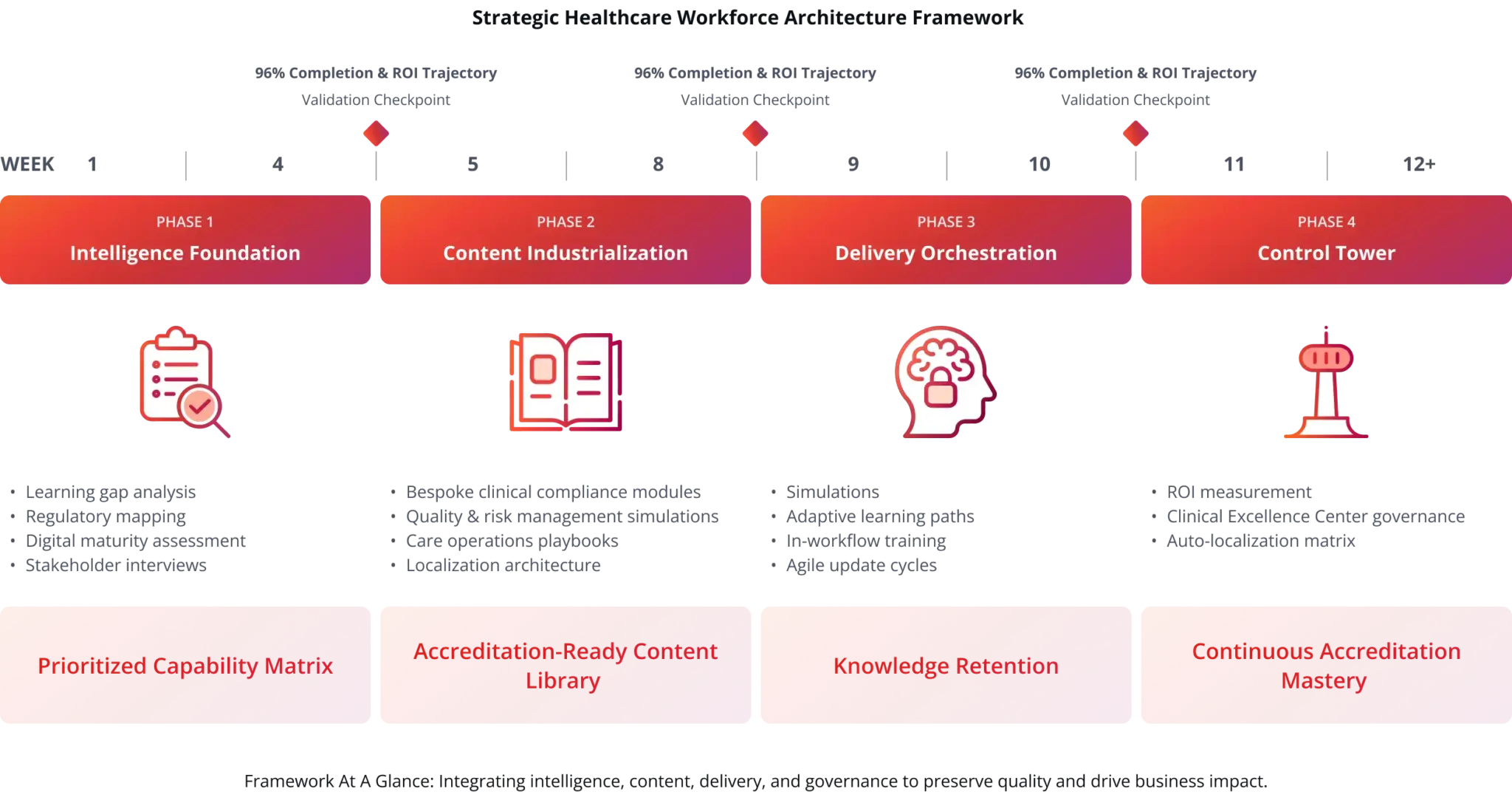
Phase 1: Intelligence Foundation (Weeks 1-4)
Start with comprehensive diagnostics to identify gaps that may otherwise go unnoticed:
- Learning gap analysis in clinical compliance, patient safety, care operations, and workforce readiness
- Regulatory mapping against JCI, NABH, CQC, HIPAA, and HITECH requirements
- Digital maturity assessment for EHR, telehealth, and interoperability readiness
- Stakeholder interviews with clinical leads, quality officers, and frontline staff
Outcome: A prioritized capability matrix with risk-weighted remediation sequencing that targets the highest-impact gaps first.
Phase 2: Content Industrialization (Weeks 5–8)
Develop role-specific learning assets aligned with accreditation standards and designed to address identified gaps:
- Bespoke clinical compliance modules: HIPAA/HITECH, infection control, medication safety, adverse event reporting
- Quality & risk management simulations: root cause analysis, patient safety frameworks, accreditation preparation
- Care operations playbooks: patient onboarding, discharge planning, digital health advisory workflows
- Localization architecture for multi-jurisdiction deployment across 15+ languages
Outcome: An accreditation-ready content library with over 50 patient safety and infection control scenarios, addressing knowledge gaps before they result in audit failures.

Phase 3: Delivery Orchestration (Weeks 9–10)
Deploy using a blended LMS/LXP infrastructure with in-workflow integration, ensuring learning occurs at the point of care:
- Simulations for clinical scenario-based decision making, accreditation prep, and EHR navigation
- Adaptive learning paths tailored to specialty-specific regulatory requirements
- In-workflow training for audit readiness and point-of-care compliance
- Agile update cycles for quarterly guideline changes and evolving clinical protocols
Outcome: Achieve 88–93% knowledge retention with real-time application at the point of care, bridging the gap between training and practice.
Phase 4: Control Tower (Weeks 11–12+)
Establish governance and measurement infrastructure to maintain excellence and prevent gaps from re-occurring: clinician reaction, learning uplift, behaviour application, and business impact:
- ROI measurement: $3.8M penalty avoidance, 42% faster accreditation audits, 3.5x business impact on patient safety
- Clinical Excellence Center governance for continuous improvement and regulatory foresight
- Auto-localization matrix for scaling to 40,000+ clinicians across jurisdictions
Outcome: Maintain accreditation mastery with zero major audit findings each quarter, supported by a scalable infrastructure that preserves quality.
Framework At A glance
Intelligence Foundation, Content Industrialization, Delivery Orchestration, and Control Tower: each phase builds on the last, with validation checkpoints at Weeks 4, 8, and 12 to ensure 96% completion and a positive ROI trajectory before full-scale rollout. This approach goes beyond training; it is strategic workforce architecture.
The 6 Essential Healthcare Leadership Domains
Clinical leadership extends beyond medical expertise. It requires navigating regulatory complexity, driving digital transformation, and building resilient teams. The six domains below form the core curriculum for Clinical Manager-to-C-Suite academies. Each domain can be delivered through a 120-hour blended program, practical leadership projects, and cohort mentoring, or integrated into your current leadership development framework.
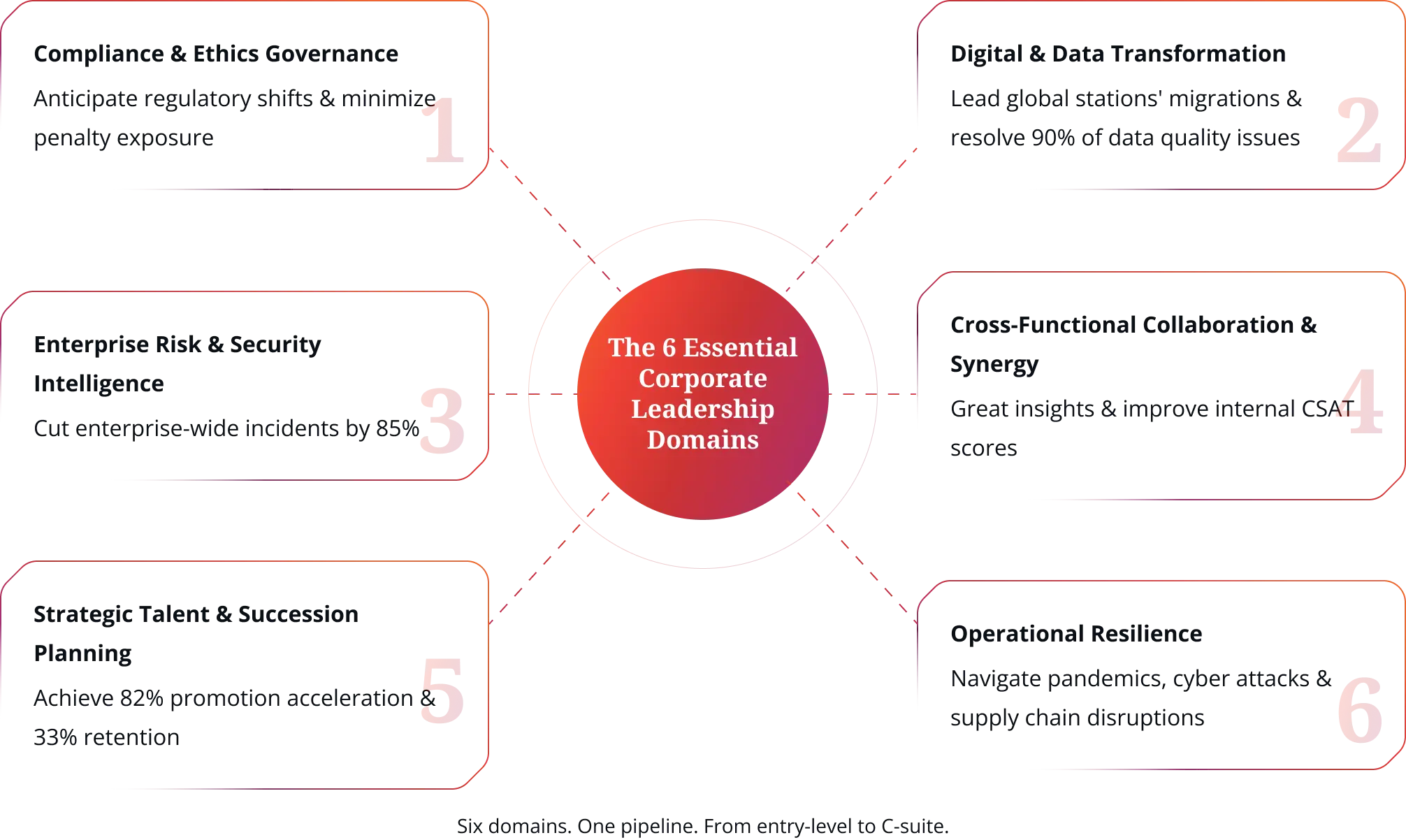
1. Regulatory Foresight: Anticipate accreditation changes, interpret multi-jurisdictional standards, and foster proactive compliance cultures instead of reactive audit responses. Leaders skilled in this area reduce the risk of penalties before they arise.
2. Digital Health Transformation: Lead EHR migrations, telehealth integration, and AI-supported clinical decision-making using change management frameworks that achieve 94% first-contact resolution. This bridges the gap between technology investment and frontline adoption.
3. Patient Safety & Risk Intelligence: Master root cause analysis, adverse event investigation, and predictive risk modelling to reduce adverse events by 35% through evidence-based decision-making. This shifts safety from a checklist to an organizational culture.
4. Cross-Functional Care Coordination: Break down silos among clinical, administrative, and quality teams to streamline discharge planning, reduce re-admissions, and improve HCAHPS scores. This addresses coordination gaps that result in significant penalties.
5. Talent Pipeline Architecture: Build succession pathways for nurse managers, clinical leads, and quality officers with targeted development, achieving 82% promotion acceleration and 93% retention. This addresses the 65% leadership gap.
6. Operational Resilience & Crisis Response: Prepare for large-scale disruptions, cybersecurity incidents, and supply chain failures through scenario-based training and business continuity frameworks. This ensures care quality is maintained under extreme stress.

Each domain includes competency assessments, 360-degree feedback, and capstone projects linked to real organizational challenges, ensuring learning translates directly into leadership capability and improved patient outcomes.
What It Takes To Make The Framework Work
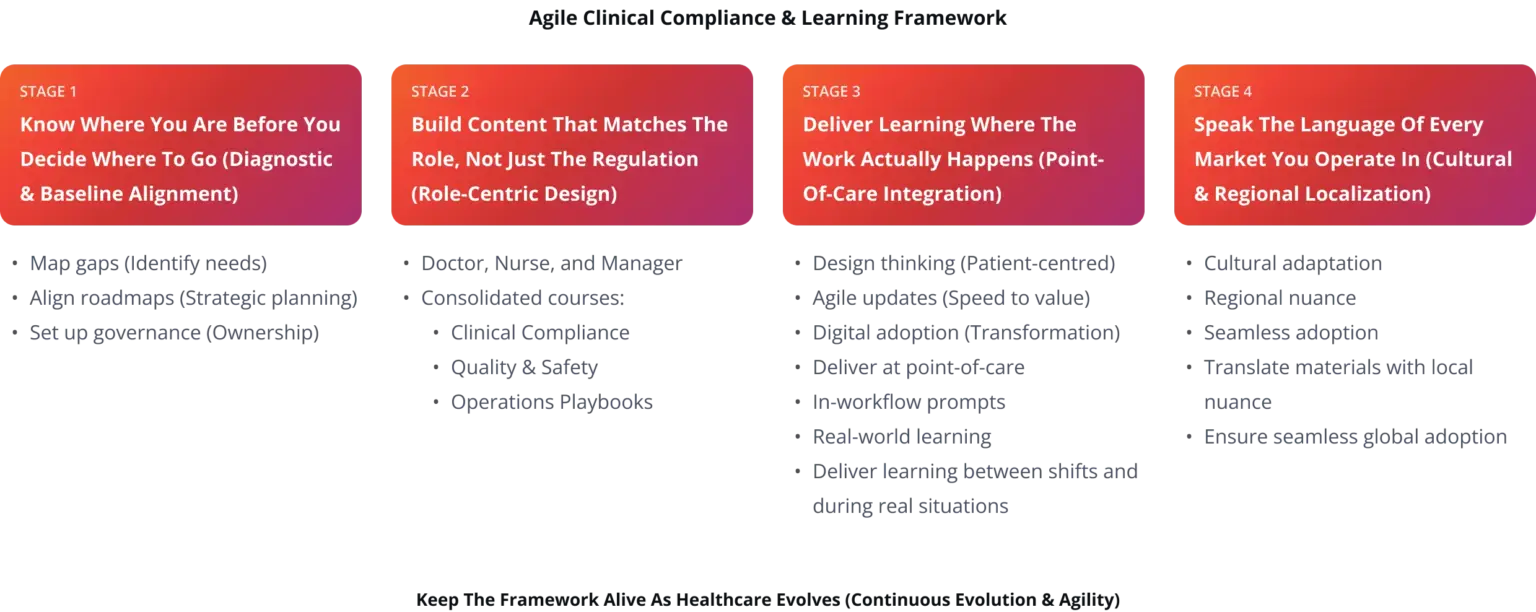
The 4-Phase Framework and 6 Leadership Domains are not plug-and-play solutions. They represent a mindset for workforce enablement that depends on five core capabilities. These can be developed internally, sourced from partners, or achieved through a combination. Ultimately, the framework remains theoretical without these foundational elements.
Know Where You Are Before You Decide Where To Go
Many compliance programs fail because they begin with content rather than diagnosis. It is essential to first identify specific gaps, such as clinicians behind on CPD, units failing audits, unprepared managers, or stalled digital adoption. Without this baseline, training investments are speculative.
- Map learning gaps across clinical compliance, patient safety, care operations, and workforce readiness
- Align L&D roadmaps to your accreditation cycle and digital health roadmap, not the other way around
- Set up governance for a Clinical Excellence Center that owns quality and compliance long-term, not just during the project
Build Content That Matches The Role, Not Just The Regulation
A compliance module designed for a quality officer will not suit a frontline nurse. Similarly, a medication safety course for a hospital may not be applicable in a clinic.
Content must be role-specific, scenario-based, and accreditation-ready from the outset. Generic materials quickly waste resources and erode clinician trust.
- Clinical compliance modules: HIPAA/HITECH, infection control, medication safety, adverse event reporting
- Quality and risk simulations: root cause analysis, patient safety frameworks, accreditation preparation
- Care operations playbooks: patient onboarding, discharge planning, digital health advisory workflows

Deliver Learning Where The Work Actually Happens
Clinicians learn between shifts, at the point of care, and during real situations, not in classrooms. Your delivery infrastructure must support this by providing tablet-based simulations, adaptive learning paths tailored to specialties, and in-workflow prompts delivered when needed, rather than according to LMS schedules.
- Simulations for clinical scenario-based decision-making, accreditation prep, and EHR navigation
- Adaptive learning paths tailored to specialty-specific regulatory requirements
- In-workflow training for audit readiness and point-of-care compliance
Speak The Language Of Every Market You Operate In
Simply translating a PDF into Spanish does not ensure usability in Madrid, Mexico City, or Manila. Cultural nuance, regional regulations, and local clinical norms are critical. Without addressing these factors, adoption will decline outside headquarters, and compliance gaps will increase in new markets.
- Translate care protocols, compliance playbooks, and patient education materials with regional language nuance
- Ensure seamless adoption across diverse healthcare networks, multi-site hospital groups, and global health enterprises
- Culturally adapt training so it drives genuine behaviour change at the frontline, not just checkbox completion
Keep The Framework Alive As Healthcare Evolves
Healthcare regulations change frequently, and new accreditation standards often arrive unexpectedly. AI tools are integrated into clinical workflows faster than most training teams can adapt. Your methodology must be designed to evolve. Static frameworks become obsolete, while agile frameworks remain effective.
- Design Thinking for patient-centered compliance and care quality improvement
- Agile for quarterly regulatory updates and evolving clinical guidelines
- Change management frameworks for EHR digital adoption and clinical transformation
Healthcare Transformation: Four Success Stories
The following cases demonstrate how healthcare organizations have used structured workforce frameworks to address compliance challenges, accelerate clinical leadership development, and scale operations across jurisdictions. These results, based on deployments, highlight what can be achieved through disciplined implementation.

1. Phasing Out Pharma Compliance Risks
A mid-sized pharmaceutical manufacturer received significant FDA Form 483 observations after nearly half of its production staff missed critical validation deadlines. This oversight resulted in a potential $2.1 million risk of a complete production halt.
The company identified knowledge gaps and replaced lengthy 200-page SOP manuals with 15-minute, scenario-based digital modules accessible on the plant floor. It also established a central Quality Excellence Center to monitor FDA readiness in real time.
Results: The $2.1 million risk was eliminated. Training completion rose to 94%, batch record errors decreased by 34%, and there were no repeat observations during the next two FDA inspection cycles.
2. Healing A Behavioural Health Network
High stress and inadequate onboarding led to a 78% turnover rate among clinical staff at a 32-facility behavioural health network. New hires lacked trauma-informed care training before treating patients, resulting in increased incident reports and state licensing violations that jeopardized Medicaid funding.
The network redesigned its onboarding to prioritize trauma-informed care and de-escalation simulations. Training was delivered through a mobile-first platform for flexible access, and a development track was created for clinical supervisors.
Results: Staff turnover decreased to 31% over the course of a year. With 91% of new hires certified before their first patient contact, licensing violations fell by 67%, securing Medicaid funding.

3. Mobilizing Home Health Care
A home health agency with 450 field nurses required staff to travel up to 3.5 hours weekly for centralized, outdated training. Fragmented care coordination also contributed to high patient readmission rates and exposure to federal penalties.
The agency addressed this by providing field training. Ten-minute micro-learning modules focused on real-world home-care scenarios were integrated into the nurses’ mobile scheduling app.
Results: Travel time was eliminated, and training completion reached 97%. Patient re-admissions decreased from 23% to 14%, nurse satisfaction increased by 41%, and the agency’s CMS Star Rating improved from 2.5 to 4.0.
4. Syncing A Global Medical Device Launch
On the brink of launching a next-generation cardiac monitor in 14 global markets, a medical device manufacturer found its sales training addressed only US regulations. As a result, 340 field representatives were unprepared for European, Japanese, and Chinese compliance laws, risking delays in the global rollout.
The company quickly mapped out market-specific regulatory tracks, building localized case studies and regional compliance scenarios. They deployed this tailored training globally via an automated learning platform, overseen by a central Regulatory Excellence Center.
The Result: The global launch timeline accelerated by 6 weeks, with all field staff certified before launch. First-year revenue exceeded forecasts by 18%, and there were no compliance issues during audits.
Outcomes: What The Framework Delivers
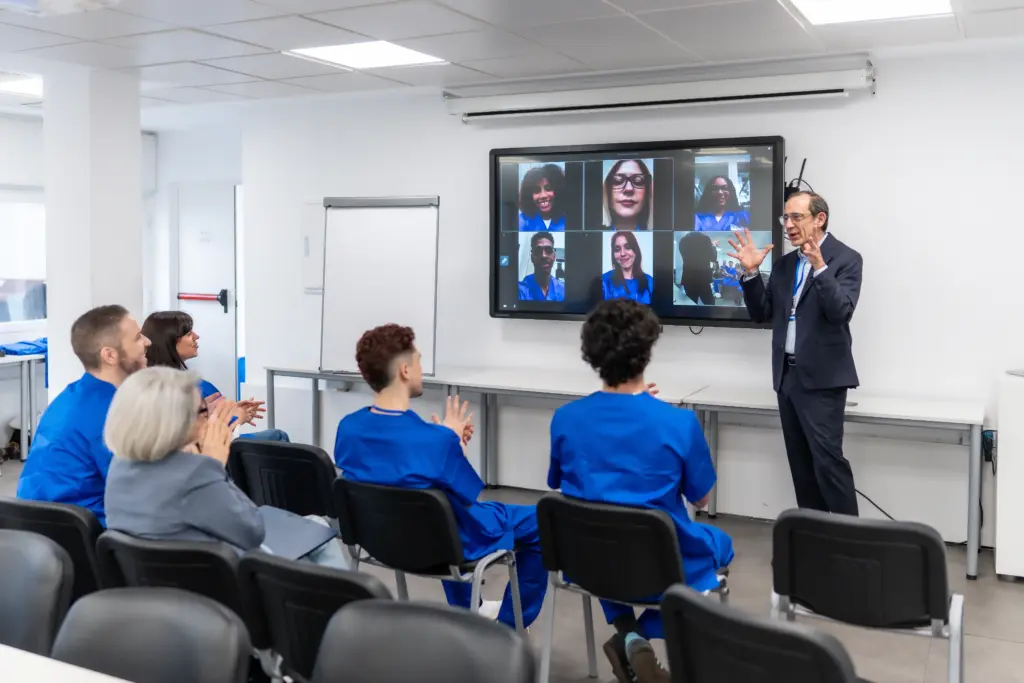
When applied consistently, the framework delivers four measurable outcomes that address hidden gaps and improve patient safety, operational efficiency, and regulatory compliance.
- Faster Accreditation & Audit Readiness
Role-specific clinical paths aligned with JCI, NABH, and CQC updates support 97% certification rates and zero major audit findings each quarter.
- Enhanced Clinical Judgment Through Scenario Training
Over 50 patient safety and infection control simulations reduce adverse events by 35% through evidence-based decision-making.
- Localized Content For Global Operations
Content is available in more than 15 languages with region-specific clinical scenarios, supporting seamless implementation across over 1,500 care sites worldwide.
- Measurable ROI On Clinical Compliance Training
Level 4 dashboards track $3.8 million in penalty avoidance, 42% faster accreditation audits, and a 3.5-fold improvement in patient safety outcomes.
ROI Benchmark

Average documented outcomes from structured framework deployment include: 42x ROI for the compliance program, 18x ROI for the leadership academy, a 32% increase in productivity, over $900,000 in penalty avoidance per deployment, and 93% retention for leadership cohorts. Actual results may vary depending on organizational readiness, baseline gaps, and implementation fidelity.
Regulatory Forecast & Strategic Imperatives
Healthcare regulations are changing rapidly. Organizations that proactively prepare for the 2026 landscape will reduce the risk of penalties and audit failures. Those who delay may face public exposure of compliance gaps.

HIPAA & HITECH Evolution
Expected 2026 updates to the HIPAA Security Rule will require encryption at rest for all clinical data, longer breach notification timelines, and clear third-party vendor accountability. Organizations should upskill IT and clinical teams together to avoid penalties exceeding $1.5 million.
JCI 7th Edition Alignment
JCI’s 7th Edition standards focus on patient-centered care metrics, quality improvement methods, and leadership accountability for safety culture. Hospitals seeking accreditation or re-accreditation must demonstrate systematic workforce competency mapping, which classroom training alone cannot provide.
NABH & CQC Convergence
Indian and UK accreditation bodies are aligning on digital documentation standards, telehealth quality benchmarks, and cross-border patient data portability. Organizations operating in multiple jurisdictions need auto-localization tools that adjust CPD hours and competency requirements by region.
AI Governance In Clinical Settings
FDA and EMA guidance on AI-assisted diagnostic tools will require clinical teams to understand algorithmic transparency, detect bias, and implement human-in-the-loop validation. Training must evolve from ‘how to use the tool’ to ‘how to govern the tool‘, a competency gap most organizations have not addressed.
Strategic Imperative
The organizations that win in 2026 will be those that treat regulatory training as a dynamic, data-driven discipline rather than an annual compliance checkbox. The 4-Phase Framework’s Agile update cycles and Control Tower governance are designed precisely for this velocity.
90-Day Deployment Roadmap
Achieving rapid value requires disciplined execution. This roadmap shortens time-to-impact while maintaining quality and accreditation standards. Use it as a template and adjust timelines to fit your organization’s needs.

Validation Gates:
- Week 4: Intelligence sign-off with clinical steering committee
- Week 8: Content validation with accreditation consultants
- Week 12: Deployment readiness review with 96% pilot completion threshold
- Week 13: Full-scale rollout authorization with ROI trajectory confirmation
By Week 13, previously hidden gaps can be identified, addressed, and monitored. Your organization will be prepared to scale.
Conclusion

These frameworks address healthcare’s dual challenges by delivering a 42x regulatory ROI and 18x leadership acceleration. They transform compliance into a $3.8 million strategic asset and develop a clinical leadership pipeline ready for C-suite roles.
Healthcare organizations that succeed in 2026 will build capable, compliant, and confident teams, prepared to manage regulatory complexity, adopt digital transformation, and deliver patient-centered care at scale. Adapt it to your context, implement internally, or collaborate with experienced specialists. The key is to begin.
Ready to Transform Healthcare Compliance & Leadership?
Contact us to learn how Chief Medical Officers, Chief Quality Officers, Clinical Directors, and Nurse Managers use these frameworks to address 58% CPD incompletion rates and 65% leadership gaps. Achieve 96% compliance mastery, 42-fold regulatory ROI, and 18-fold leadership acceleration while developing clinical talent for C-suite roles.
We tailor deployment for organizations with 500 to 40,000 clinicians, starting with a 90-day pilot that includes live dashboards, over $900,000 in value realization for 1,000 clinicians, and accreditation readiness across key jurisdictions and care units.
Recommended
Explore the Wordsburg Digital Readiness Framework to master healthcare’s digital transformation and AI skills crisis with clinically sensitive, operationally realistic learning architectures. Designed for fast-paced medical environments, it drives training engagement to 70-90%, improves knowledge retention by 75% through VR simulations, and makes tech implementations 2-3x more likely to succeed.
Access segment-specific diagnostic assessments, 5-10-minute clinical microlearning modules, AI-adaptive pathways, and 4-level Kirkpatrick ROI dashboards; proven to accommodate demanding shift patterns, reduce workflow errors, and scale digital fluency across your entire system.