
The Complete Strategic Guide to Agility, Innovation & Sustained Growth
Introduction
In today’s volatile business landscape, agility without foundational methodologies breeds chaos. Leaders across industries face mounting pressures: accelerating digital transformation, navigating resistance to change, scaling globally while preserving quality, and justifying investments amid economic uncertainty.
Our Methodology & Framework Development transforms these challenges into competitive advantages. This comprehensive guide reveals seven battle-tested strategic blueprints that empower enterprise leaders to drive transformational outcomes—backed by validated ROI data and proven enterprise deployments.
The Numbers That Matter:
- 353% ROI from iterative agile methodologies ($4.53 return per $1 invested)
- 85%+ returns via human-centered design principles (40% engagement uplift)
- 2.5x faster delivery using integrated frameworks (30% cycle acceleration)
- 70% sustained adoption through strategic change integration (vs. 30% industry standard)
- 40% variance reduction across global operations (consistent worldwide quality)
This is your playbook for excellence. Inside, discover how to integrate methodologies, embed measurement systems, scale globally, and deliver lasting ROI.
Part 1: The Agility Imperative—Why Foundational Methodologies Matter
The Challenge Leaders Face
Agility is no longer aspirational—it’s existential. Organizations must pivot faster, innovate continuously, and scale reliably. Yet 60% of transformation initiatives fail due to misaligned frameworks, siloed execution, and insufficient measurement systems. Generic methodologies waste resources. Custom blueprints deliver results.
What Sets Frameworks Apart
Frameworks for Impact differ from standard consulting because they:
- Integrate Methodologies: Agile, design thinking, change management, and continuous improvement operate as one ecosystem, not isolated initiatives
- Embed Measurement: Every framework includes KPIs, dashboards, and feedback loops for real-time course correction
- Scale Globally: Centralized governance meets local adaptation, reducing delivery variance by 40%
- Combine Art & Science: Structured processes meet human-centered empathy for lasting cultural shifts
- Deliver Fast: MVP deployments in 30-60 days, not 12-month implementations
The ROI Story
Organizations adopting these frameworks report:
- 353% average ROI from agile and design thinking initiatives
- $4.53 return per $1 invested in strategic transformation
- 20-50% annual performance uplift via continuous cycles
- 70% sustained change adoption vs. 30% industry standard
Part 2: The Seven Core Frameworks
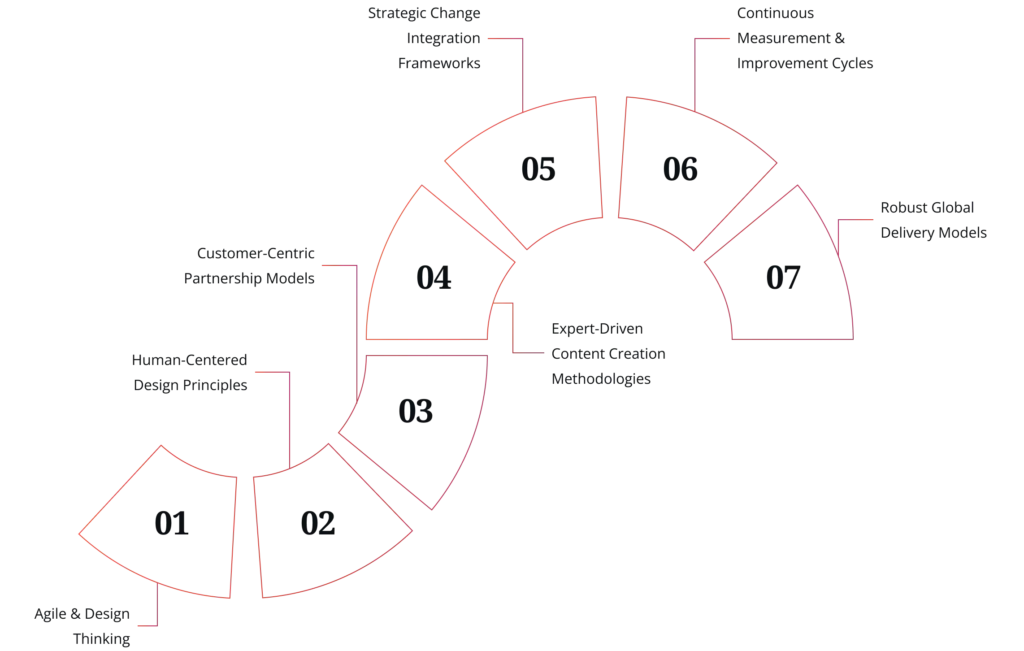
In today’s hyper-competitive landscape, where digital transformation, regulatory compliance, and global scaling demand precision and adaptability, generic strategies fall short. The Seven Core Frameworks—battle-tested blueprints engineered for enterprise excellence. These deployable systems fuse methodologies such as Agile, human-centered design, and continuous improvement with metrics including 3x faster time-to-market, 70% sustained change adoption, and 400% marketing ROI.
Tailored for product teams, CX leaders, global ops, and transformation PMOs, each delivers Who, What, When, Where, Why, How—with tactical processes and impacts for accelerating MVPs, cultural intelligence, or content-to-revenue plays.
Framework 1: Agile & Design Thinking

Custom Blueprints for Iterative Problem-Solving & Innovation
What It Is
Agile & Design Thinking Frameworks integrate sprint-based execution with empathy-driven ideation, blending structured velocity with creative exploration. We fuse Agile iterative cycles with design thinking’s five phases—empathize, define, ideate, prototype, test—creating adaptive solutions for complex challenges.
How We Deploy It
Who: Product, IT, and innovation teams needing rapid iteration
What: Custom blueprints combining agile sprints with design thinking empathy-prototype-test cycles
When: For MVPs, digital transformations, or market pivots (2-6 month cycles)
Where: Cross-functional teams globally, hybrid/remote environments
Why: Achieves 3x faster time-to-market, 25% higher success rates
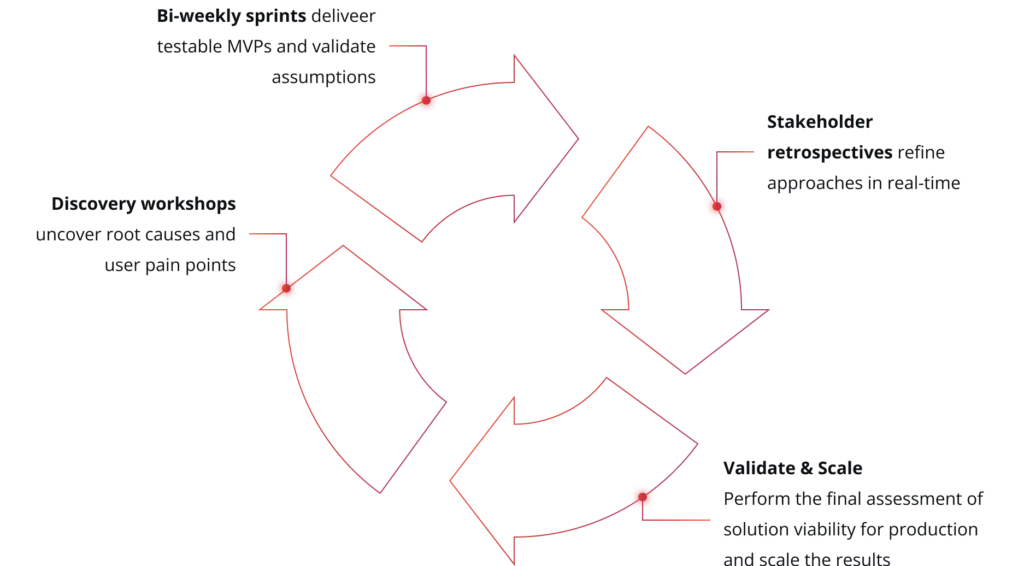
How: Week 1 empathy workshops → bi-weekly sprints → monthly retrospectives → validate and scale solutions
Tactical Process:
The Impact
- 3x faster time-to-market vs. waterfall approaches
- 25% higher innovation success rates through user validation
- 30% faster delivery cycles across teams
- 353% average ROI from iterative methodologies
- Teams gain velocity, creativity, and resilience in volatile conditions
When to Use
Best for product development, digital transformation initiatives, customer experience redesigns, and agile organizational restructures.
Framework 2: Human-Centered Design Principles

Prioritizing User Needs, Behaviors & Experiences
What It Is
Human-Centered Design Principles anchor every decision in rigorous user research, behavioral insights, and experiential validation. This approach treats user empathy as non-negotiable, evolving solutions based on how people work, not how we assume they should.
How We Deploy It
Who: UX, product, and customer experience leaders
What: User-first methodology embedding behaviors and needs throughout design
When: New product launches, service redesigns, digital experiences (3-4 month cycles)
Where: Customer-facing teams worldwide
Why: Delivers 85%+ ROI, 40% productivity gains, 35% reduced rework
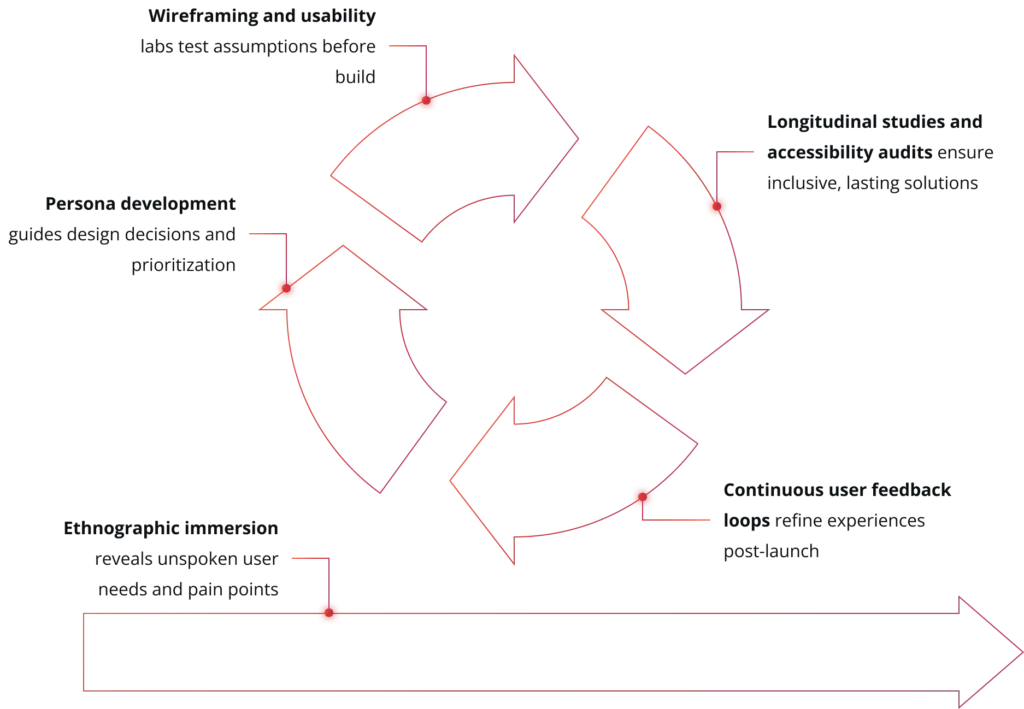
How: Discovery (ethnography) → personas → prototyping → testing → iterate longitudinally
Tactical Process:
The Impact
- 85%+ ROI with superior cost-benefit ratios
- 40% engagement uplift and higher user satisfaction
- 35% reduction in support tickets via intuitive design
- 87% capability uplift in user mastery and proficiency
- Organic advocacy and reduced churn from loyal users
When to Use
Best for SaaS platforms, customer portals, internal tools, mobile applications, and any user-facing initiative requiring adoption at scale.
Framework 3: Customer-Centric Partnership Models
Collaborative Strategies Aligning Teams for Mutual Success
What It Is
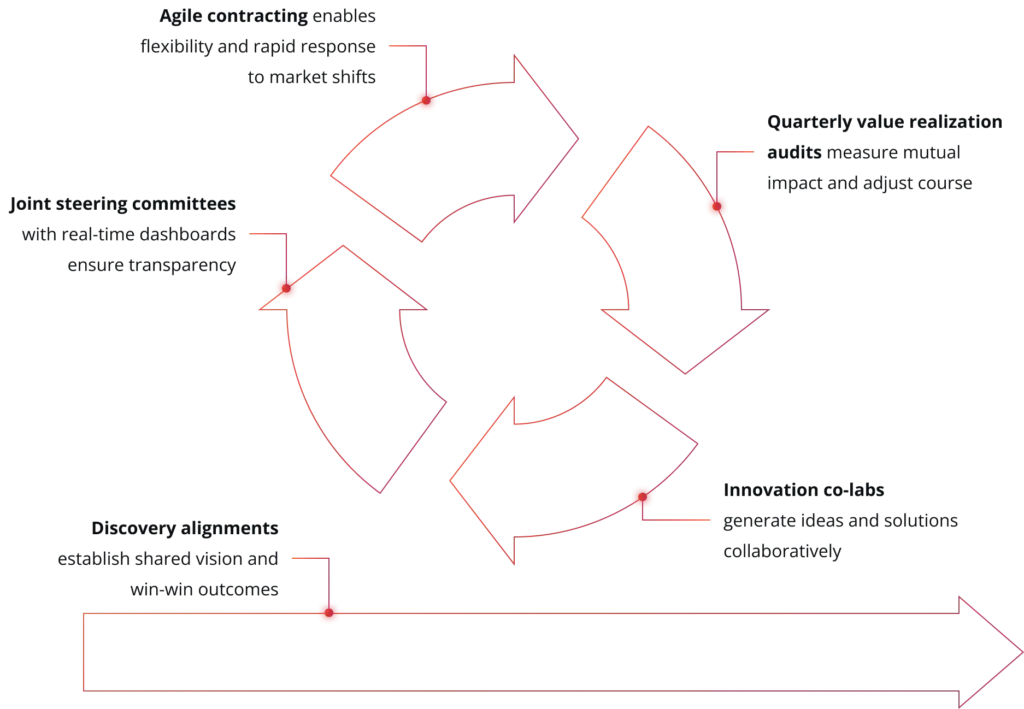
Customer-Centric Partnership Models architect symbiotic engagements through co-defined roadmaps, shared innovation labs, and performance-linked incentives. Relationships evolve from transactional to transformational, with alignment at every level—executive, operational, and tactical.
How We Deploy It
Who: Business development, account management, alliance leads
What: Collaborative ecosystems with shared KPIs and co-creation labs
When: Strategic partnerships, vendor alignments, client co-innovation (ongoing)
Where: B2B relationships globally
Why: Delivers 60% retention uplift, 35% efficiency gains, 2.4x revenue success
How: Alignment workshops → joint governance → value dashboards → quarterly business reviews
Tactical Process:
The Impact
- 60% retention uplift and deeper customer loyalty
- 35% cost efficiencies through aligned operations
- 2.4x revenue success for partnership-focused organizations
- Higher Net Promoter Scores and organic referrals
- Relationships become revenue engines with embedded mutual success
When to Use
Best for strategic vendor relationships, joint ventures, channel partnerships, client-agency engagements, and enterprise collaborations requiring sustained alignment.
Framework 4: Expert-Driven Content Creation Methodologies

Structured Approaches for Generating High-Impact, Authoritative Assets
What It Is
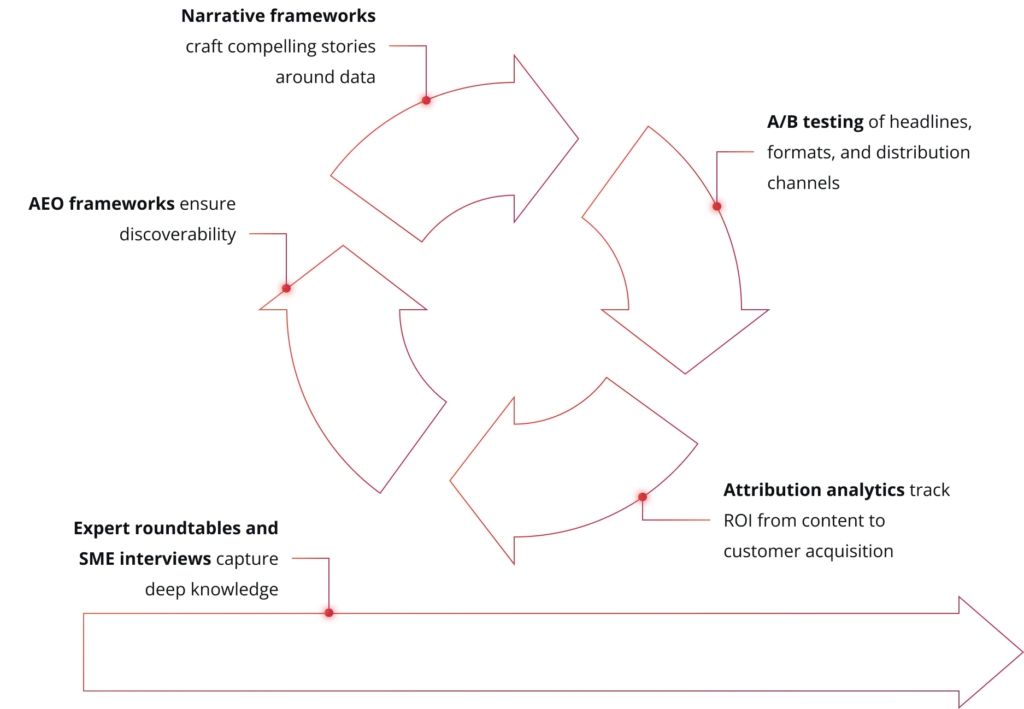
Expert-Driven Content Creation Methodologies harness domain specialists in a structured pipeline—research synthesis, outline validation, multimedia production, omnichannel syndication. Content becomes a strategic asset that educates, persuades, and establishes thought leadership.
How We Deploy It
Who: Marketing, comms, and thought leadership teams
What: SME-powered pipeline from research to omnichannel amplification
When: Brand positioning, lead generation campaigns, authority building (ongoing)
Where: Content operations worldwide
Why: Delivers 400% marketing ROI, 25% shorter sales cycles, 40-60% lead quality gain
How: Expert synthesis → narrative frameworks → AEO optimization → multi-channel deployment
Tactical Process:
The Impact
- 400% marketing ROI via high-performing assets
- 40-60% improvement in lead quality and engagement
- 20-30% sales cycle reduction through nurture sequences
- 353% ROI when integrated with other frameworks
- Thought leadership positioning that commands premium pricing
When to Use
Best for B2B companies seeking positioning, whitepapers and gated assets, case study libraries, webinar and training series, and SEO/content-driven demand generation.
Framework 5: Strategic Change Integration Frameworks
Comprehensive Methodologies for Planning, Executing & Sustaining Transformation
What It Is
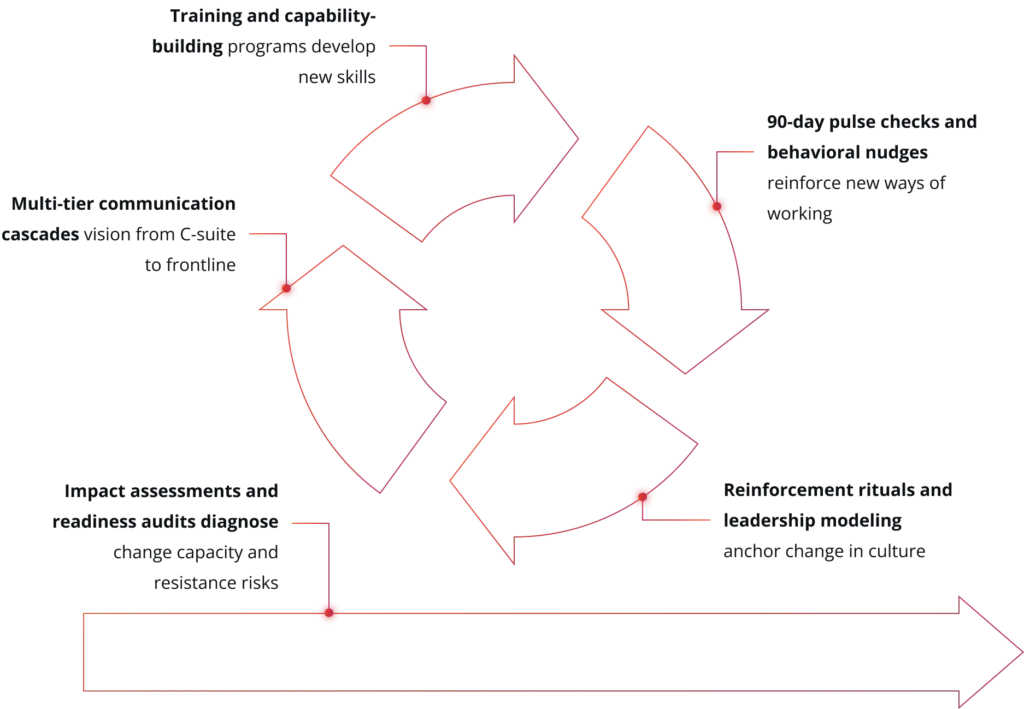
Strategic Change Integration Frameworks map holistic change journeys blending ADKAR models, Kotter’s 8-step process, and Prosci diagnostics. Change becomes embedded in culture, not a temporary initiative—ensuring 70% sustained adoption vs. 30% industry average.
How We Deploy It
Who: Transformation PMOs, change managers, executives
What: ADKAR-Kotter hybrid for end-to-end change journeys
When: Org restructures, tech adoptions, culture shifts (6-12 month cycles)
Why: Achieves 70% sustained adoption vs. 30% industry failure rate
Where: Enterprise-wide implementations
How: Readiness diagnostics → stakeholder cascades → reinforcement rituals → 90-day audits
Tactical Process:
The Impact
- 70% sustained adoption rates and lasting cultural shifts
- 29% average ROI from integrated change methodologies
- Competitive advantage through embedded new capabilities
- Reduced resistance and burnout via empathetic change management
- Faster ROI realization from transformation initiatives
When to Use
Best for organizational restructures, system implementations (ERP, CRM), mergers and acquisitions, cultural transformations, and major process re-engineering.
Framework 6: Continuous Measurement & Improvement Cycles
Systems for Ongoing Evaluation, Feedback Integration & Iterative Enhancement
What It Is
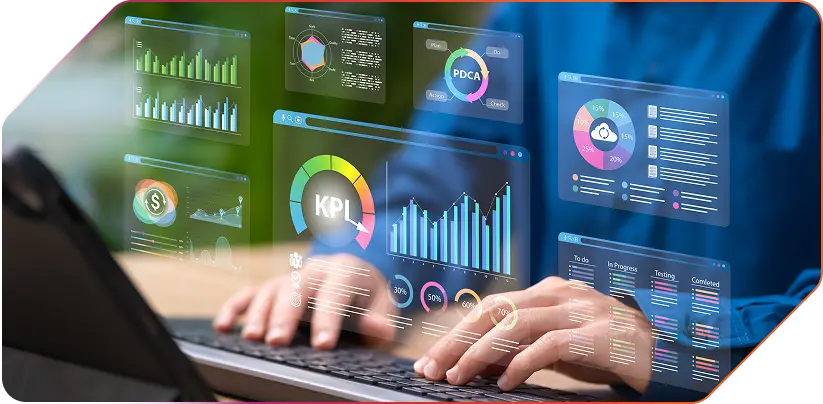
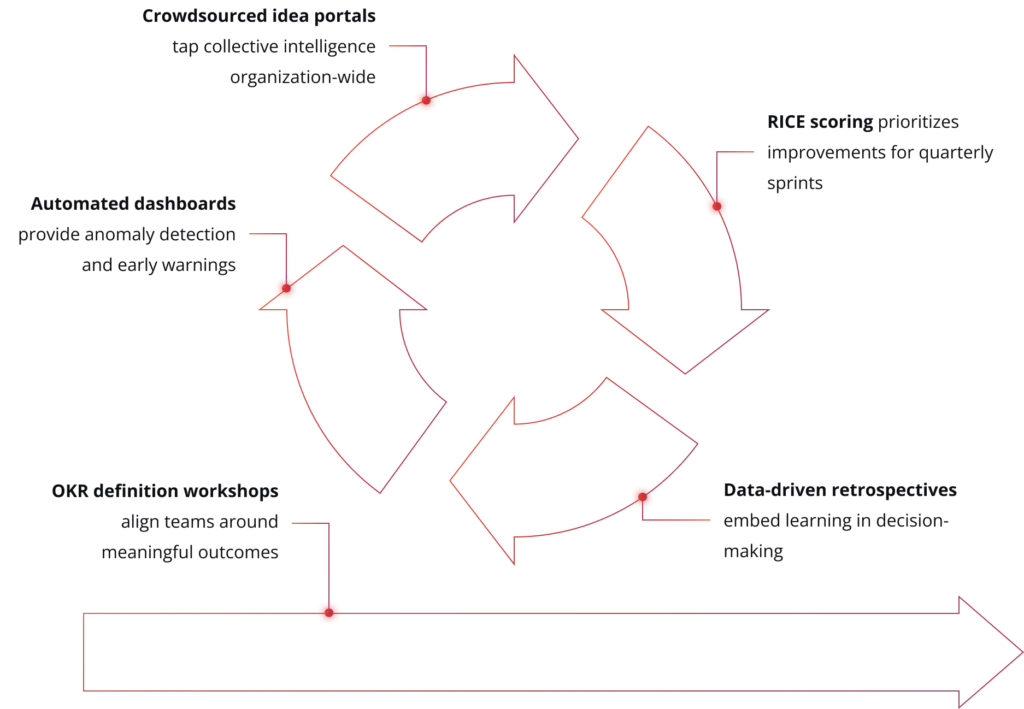
Continuous Measurement & Improvement Cycles leverage Plan-Do-Check-Act (PDCA) loops augmented by Objectives and Key Results (OKRs), real-time Net Promoter Score (NPS) surveys, and AI-powered predictive analytics. Organizations evolve from annual reviews to perpetual refinement, compounding performance gains year over year.
How We Deploy It
Who: Operations, performance, and quality teams
What: PDCA-OKR loops with real-time analytics and feedback integration
When: Ongoing optimization, post-project refinement (continuous)
Where: Functional excellence centers
Why: Delivers 20-50% annual compounded gains organization-wide
How: Baseline KPIs → automated dashboards → idea portals → Reach, Impact, Confidence, and Effort (RICE)-prioritized sprints
Tactical Process:
The Impact
- 20-50% annual performance uplift through compounding gains
- Faster decision cycles via real-time data and insights
- Higher employee engagement through meaningful feedback loops
- Exponential ROI growth from sustained improvement initiatives
- Kaizen mindset where continuous improvement becomes cultural norm
When to Use
Best for operational excellence programs, manufacturing and service optimization, customer experience enhancement, and any organization seeking sustained competitive edge.
Framework 7: Robust Global Delivery Models

Scalable & Consistent Frameworks For Cross-Border Execution
What It Is
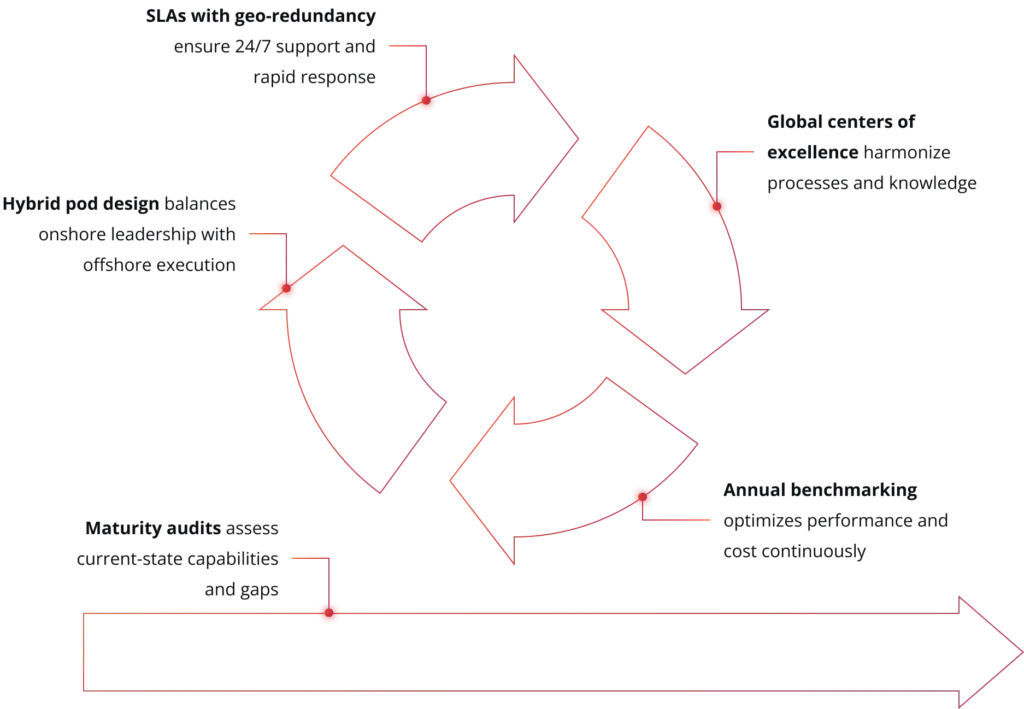
Robust Global Delivery Models fuse centralized governance with localized execution using hybrid pod structures, cultural intelligence training, and federated technology platforms. Scale becomes seamless across time zones and regions while preserving quality and consistency.
How We Deploy It
Who: Global ops, program directors, regional leads
What: Hybrid onshore-offshore with cultural intelligence governance
When: Multi-region rollouts, standardized scaling (ongoing)
Where: International enterprise operations
Why: Achieves 40% delivery variance reduction
How: Maturity audits → geo-redundant SLAs → centers of excellence → annual benchmarking
Tactical Process:
The Impact
- 40% reduction in delivery variance across regions
- Predictable quality regardless of geographic location
- Cost optimization through optimal resource allocation
- Seamless scaling to new markets without operational friction
- Cultural adaptation maintaining excellence with local relevance
When to Use
Best for multinational enterprises, distributed teams, customer-facing global operations, and organizations expanding into new regions.
Part 3: Proven Results—Stats That Validate Impact

Strategic frameworks deliver transformative business outcomes. These industry-validated metrics demonstrate why custom blueprints consistently outperform generic solutions, providing leadership teams with data-driven confidence to invest.
Framework ROI & Performance Metrics
| Framework | Key Metric | Result | Impact |
|---|---|---|---|
| Agile & Design Thinking | Average ROI | 353% | $4.53 per $1 invested |
| Human-Centered Design | ROI Range | 85%+ | 40% engagement uplift |
| Customer Partnerships | Retention | 60% increase | 35% cost efficiency |
| Expert Content | Marketing ROI | 400% | 40-60% lead quality gain |
| Change Integration | Adoption Rate | 70% sustained | vs. 30% industry standard |
| Continuous Improvement | Annual Uplift | 20-50% | Compounding performance gains |
| Global Delivery | Variance Reduction | 40% | Consistent quality worldwide |
Integrated Framework Impact
- 2.5x faster delivery across iterative frameworks
- 87% capability uplift in targeted programs
- 29% average ROI from integrated methodologies
- 2.4x revenue success for partnership-focused organizations
- 237% commercial performance uplift from holistic approaches
Part 4: How Frameworks Work Together—The Integrated Ecosystem
The true power emerges when frameworks operate in concert, not in isolation.
The Framework Ecosystem Synergy
Scenario: Digital Transformation Initiative
- Agile & Design Thinking accelerates innovation sprints
- Human-Centered Design ensures user adoption and satisfaction
- Expert Content builds stakeholder buy-in through thought leadership
- Customer-Centric Models align partners and cross-functional teams
- Strategic Change embeds new ways of working in the culture
- Continuous Measurement tracks progress and optimizes quarterly
- Global Delivery scales proven approaches across regions
Result: Faster transformation, higher adoption, sustained competitive advantage.
Part 5: Implementation Pathways—Getting Started
The Wordsburg Approach

Timeline: From assessment to ROI realization in 90-180 days.
Part 6: Why Leaders Choose Frameworks For Impact
The Competitive Advantage
Organizations leveraging these frameworks gain:
- Speed – 3x faster delivery and time-to-market
- Quality – 40% reduction in rework and support costs
- Adoption – 70% sustained change vs. 30% industry standard
- ROI – 353% average return on strategic investments
- Culture – Embedded continuous improvement mindset
- Scale – Consistent execution across geographies
- Resilience – Adaptability and agility in volatile environments
What Success Looks Like
“Before Wordsburg’s frameworks, our transformation felt scattered. Now we have integrated methodologies, clear metrics, and sustained adoption. We’ve realized 287% ROI in year one and built a culture of continuous excellence.“
– VP Transformation, Global Enterprise
Conclusion: Your Blueprint For Excellence Awaits
Agility demands foundational methodologies. This guide has revealed seven proven frameworks—each validated through enterprise deployments and benchmarked against industry standards. The question isn’t whether to invest in frameworks; it’s which ones will unlock your competitive advantage fastest.
Ready to transform with tailored Frameworks for Impact to your specific challenges—from strategic clarity to execution at scale? Our experts assess, design, accelerate, and scale proven methodologies aligned to your goals and operating context. Schedule your complimentary strategy consultation with Wordsburg today to map the next steps for your organization’s impact journey.
Recommended
Explore our evidence-based enterprise readiness briefing, revealing how leaders transform workforce capability into measurable strategic advantage. Anchored in Wordsburg’s Maturity Framework, this analysis decodes the five dimensions shaping execution success — leadership, change, skills, culture, and measurement.
Grounded in real-world data and enterprise case patterns, it helps you bridge the ambition–execution divide, benchmark organizational readiness, and prepare to lead transformation in 2026 and beyond.