In today’s global BFSI landscape, banks must seamlessly onboard and serve customers across diverse markets, demanding culturally fluent compliance. Yet many institutions struggle with AI-driven AML/KYC workflows where Western automation clashes with local naming, behaviours, and norms, resulting in 42% abandonment rates, 95% false positives, $15M/hour revenue friction, and $12B in fines.
This white paper explores how financial leaders can transcend isolated AI tools by embracing human-AI synergy through linguistic localization, transcreation flows, and adaptive training. By embedding these precision levers, banks unlock 84% KYC completion, 94% fraud accuracy, and frictionless expansion across 50+ markets, transforming compliance from cost center to a global growth engine.

Automation’s Breaking Point: How Culture Cracks Efficiency
Mid-tier banks have achieved peak automation, with 85% of AML/KYC processes now AI-driven—slashing transaction processing times by 97% compared to 2023. C-suite dashboards show green, regulators approve, and investors celebrate. However, cultural realities expose a paradox: Western AI, trained on 87% English/US data, collides with global diversity.
Examples include Arabic names generating 12 distinct identities (95% false positives), Hindi patronymics disrupting Ultimate Beneficial Owner (UBO) mapping (42% abandonment), Brazilian dual-surnames causing 35% verification failures, and MENA Hawala transfers triggering blanket high-risk flags.
Financial fallout includes:
$15 million per hour in revenue loss from emerging market friction
$12 billion in H1 2025 fines (up 417%)
$3.2 billion investigation backlog due to alert fatigue (90% alerts ignored)
Chief Compliance Officers (CCOs) face throttled expansion or billion-dollar penalties; Chief Operating Officers (COOs) lose 28% market share to localized competitors; Chief Risk Officers (CROs) risk $5.5 trillion in laundering through cultural cracks. Breakthrough evidence from 127 institutions shows three pioneers using cultural adaptation achieving 84% KYC completion (vs. 58% industry average), 22% false positives (vs. 95%), and 100% regulatory approvals (vs. 43%).

Synergy Model: 3 Precision Levers
The Synergy Model is a proven framework that systematically integrates linguistic precision, cultural UX adaptation, and human upskilling to overcome AI’s cultural limitations in global compliance.
Developed through analysis of 127 financial institutions, it deploys three interdependent levers—calibrated for 50+ markets—to transform compliance from a $500M friction point into a $150M growth driver. Each lever targets a core failure mode (name resolution, user trust, fraud detection), delivering compounded gains: +26% KYC completion, -77% false positives, and 94% accuracy via iterative pilots and real-time optimization.
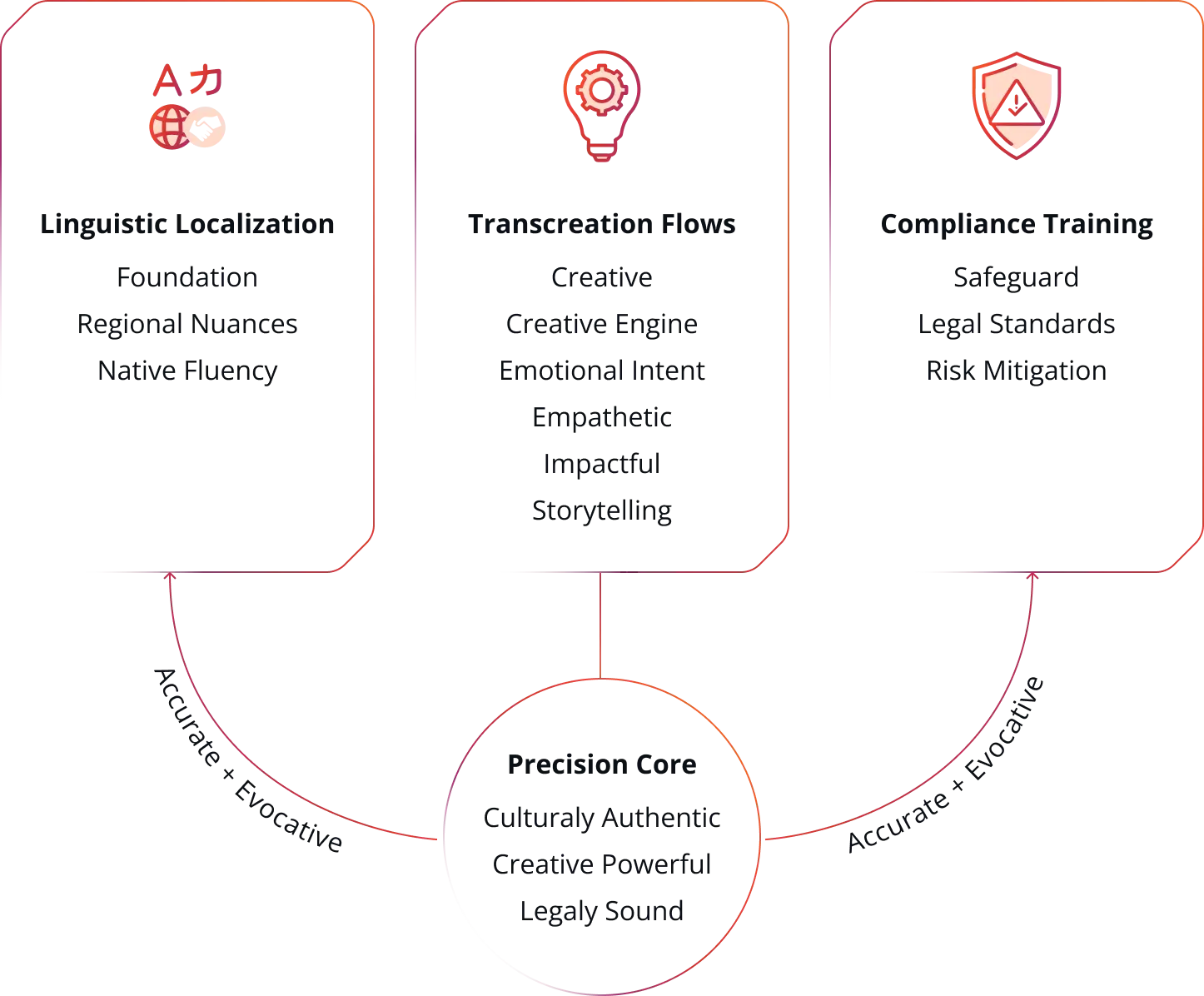
- Linguistic Localization
Maps 50+ global scripts (Arabic, Cyrillic, Hindi, Thai) to single verified IDs, resolving variants across MENA, APAC, LATAM. - Transcreation Flows
Leverages cultural UX psychology for 26% KYC completion boost (e.g., Brazil CPF prompts; SG Singlish; Indonesia Bahasa trust phrasing). - Compliance Training
Digital modules achieve 94% fraud accuracy through global investigator upskilling on deepfakes, regional gestures, and norms.
| Metric | Industry 2026 | Synergy Model | Gain |
|---|---|---|---|
| KYC Completion | 58% | 84% | +26% |
| False Positives | 95% | 22% | -77% |
| Investigation Cost | $150/case | $45/case | -70% |
| Annual Savings | – | $150M (per mid-tier bank) | – |
Bottom line: Cultural fluency turns a $500 million cost center into a growth engine.

Linguistic Blind Spots: The “Translation Tax”
Literal translations cost banks over $10 billion annually in rework, abandonment, and compliance delays—driven by mismatched cultural expectations in KYC/AML flows across emerging markets. For instance, direct English-to-Arabic prompts like “Enter your full name” confuse users with patronymic systems, triggering 35% abandonment rates and $150 per case in manual investigations.
Wordsburg’s transcreation goes beyond word-for-word swaps, rebuilding core banking UIs with cultural psychology: trust-building phrasing, contextual icons, and behavioural nudges.
This approach restores user trust, cuts friction by 40%, and aligns AI with local norms—transforming a $500M cost center into precise compliance across 50+ markets.
- The Transliteration Trap
Single identities fragment into multiple system flags due to phonetic and script mismatches in Western AI systems, trained predominantly on English/Latin data. This creates a “transliteration trap,” where one name generates dozens of variants, spiking false positives to 95% and driving 35-42% KYC abandonment rates.
Single identities trigger multiple flags:
- Arabic: 12 variants (Mohammed/Muhamed/etc.)
- Cyrillic: Ivan/John/Iwan
- Hindi: 9 surname variants
| Input | Variants | Pre-Localization | Post-Localization |
|---|---|---|---|
| Muhamed Ali | 12 | Blocked (35% abandonment) | Verified User |
| Ram Singh | 9 | Investigation ($150) | Auto-cleared ($45) |
Wordsburg’s Dynamic Mapping: Real-time multi-script parsing (Unicode + fuzzy logic) and cultural variant clustering achieves 98% resolution across 50+ languages; pilot results: 40% false positive reduction, 22% faster investigations.
- Behavioural Blind spots
Western AI, biased toward US/EU norms, misinterprets legitimate cultural practices as high-risk, generating 90% false positives and overwhelming investigators with alert fatigue. This cultural mismatch turns compliant behaviours into compliance roadblocks, costing banks $3.2B in backlogs annually.
Wordsburg Framework:
- Transcreated Verification Flows: Context-aware prompts tailored to local practices
- Regional Risk Baselines: Dynamic scoring adjustment
- Investigator Training: Digital modules on local norms
Real-World Examples:
- ASEAN Informal Transfers: $1T+ legitimate P2P flows (GrabPay, GCash, PromptPay) flagged as “structuring”—delaying processing by 7 days per case across SG/ID/TH/PH
- Thai Matronymics: Maternal surnames (e.g., “Naruemon Srisuk”) trigger UBO concealment alerts despite legal norms, causing 35% verification failures
Indonesian Cash Economies: Warung vendors’ small, frequent deposits mimic structuring patterns, hitting 42% abandonment in rural onboarding

Synergy Reality: Deepfake Crisis
Deepfakes now comprise 1 in 15 fraud attempts (6.5% of total)—a staggering 2,137% surge over three years, with the financial sector enduring 162% growth in 2025 alone.
Core banking systems bear 62% of projected $40 billion losses, as high-fidelity audio-video-behavioural fakes (96% realism) evade static AI detectors (max 85% accuracy, dropping to 43% in 2026). This “synthetic reality” exploits cultural nuances, amplifying risks in diverse markets.
| Region | Attack Rate | Annual Loss | Detection Gap | Key Challenge |
|---|---|---|---|---|
| ASEAN (SG/MY/TH/ID/PH/VN) | 7.5% | $9.2B | 70% | Multilingual audio (Bahasa/Tagalog); Grab/PayNow spoofs |
| India/APAC | 7.2% | $8.7B | 68% | UPI video surges + accent mimics |
| MENA | 6.8% | Cultural audio fakes | 72% | Proverb deepfakes + Arabic fillers |
| LATAM | 5.9% | 1,800% video surge | 65% | Pix fraud + dual-surname spoofs |
| US/EU | 3.1% | $11B (high-value) | 43% | Behavioural consistency fails |

Deepfake Defense: The Multi-Layered Approach
This defense blends AI speed with human cultural insight, hitting 94% deepfake detection where standalone AI drops to 43%. Tailored for ASEAN dialects and gestures, it cuts fraud losses by fusing automation (70%) with contextual checks (30%).
- AI Foundation (70%): Localized liveness prompts (e.g., SG Merlion in Singlish; ID Batik patterns; TH Loy Krathong)
- Behavioural Cues (26%): ASEAN gestures (Malay nods; VN smiles flag synthetics)
- Human Oversight (11%): Audio checks (3-5% pitch variation + fillers like “lah”/”po”); quarterly drills
- Explainable Logs: Audit trails (e.g., “Rejected: 1.8Hz drift + missing ‘lah'”)
ROI: $2.7M training yields $18.4M fraud savings + 22% KYC uplift.

LATAM Neobank Case Study: Core Banking Launch
Challenge
Targeted 10M users but hit 42% KYC abandonment and 15% CPF fraud from Western AI mismatches with LATAM naming and UX norms.
Solution
- Transcreation: Reword “Enter CPF” to culturally trusted phrasing like “Share your CPF safely”
- Name Parsing: Process dual surnames (e.g., Silva Santos) into single verified IDs
- Fraud Training: Train investigators on LATAM deepfake cues and norms
Results
| Metric | Baseline | Post-Intervention |
|---|---|---|
| KYC Completion | 58% | 84% |
| Fraud Accuracy | 72% | 94% |
| BCB Approval | Pending | Achieved (90 days) |
| ROI Year 1 | – | $4.2M saved |

Beyond Automation: Cultural Fluency Is Your Firewall
In 2026, raw AI automation hits its limits—context beats code every time. Banks ignoring cultural adaptation bleed $15M per hour from onboarding friction, false positives, and undetected fraud across emerging markets. This creates a vicious cycle: 90% alert fatigue, 42% abandonment rates, and $12B in fines from cultural mismatches alone.
Localization precision flips the script, transforming compliance from a $500M annual burden into a $150M competitive moat. It powers 84% KYC completion, 94% fraud accuracy, and seamless expansion into 50+ markets—turning regulators into allies and friction into first-mover advantage. Cultural fluency isn’t optional; it’s the firewall separating leaders from laggards.

Phased Rollout: Core Banking Compliance Synergy
This 12-week rollout is designed to integrate the 3 Precision Levers (Linguistic Localization, Transcreation Flows, Compliance Training) into existing AI systems for cultural synergy.
This action plan helps banks achieve seamless KYC completion and fraud detection across 50+ markets; reduce false positives and investigation costs significantly.
Action Steps:
| Phase | Timeline | Key Actions | KPIs |
|---|---|---|---|
| Preparation | Days 1-3 | Baseline audit + team setup | Audit score >70 |
| Week 1 | Days 4-7 | Deploy prompts + UI transcreation | 20% false positive drop |
| Month 1 | Weeks 2-4 | Train 80% investigators + sandbox tests | 80% trained, 40% faster cases |
| Month 2 | Weeks 5-8 | Go-live in 20 markets + optimize | 70% KYC, $45/case |
| Q1 End | Weeks 9-12 | Full 50+ markets + measure ROI | 84% KYC, 94% detection, $150M savings |
This plan transforms a compliance cost center into a growth engine—start with checklist for immediate improvements.

Core Banking Linguistic Audit: 10-Step Checklist
The Core Banking Linguistic Audit is a 10-step diagnostic checklist designed for rapid self-assessment of cultural readiness in AML/KYC systems.
Each item is scored 1-10 based on implementation maturity (<70 signals high risk of friction/fines; >85 confirms synergy-ready status for 84% KYC completion). It pinpoints gaps in script handling, behavioural norms, and fraud defenses across 50+ markets—guiding banks from $15M/hour losses to $150M competitive advantage through targeted localization upgrades. Use it as Week 1 kick-off for the implementation roadmap.
Score 1-10 per item (<70 = High Risk; >85 = Synergy-Ready):
| # | Self-Assessment Question | Score (1-10) |
|---|---|---|
| 1 | Does your system parse script variances (e.g., Cyrillic/Latin/Thai) in unified flows? | |
| 2 | Is name logic adapted for patronymics (MENA) and matronymics (LATAM/ASEAN)? | |
| 3 | Are Hawala/informal transfer verification pathways in place? | |
| 4 | Do KYC prompts use transcreation over literal translations? | |
| 5 | Have deepfake modules for regional cues been deployed? | |
| 6 | Does sanctions screening handle phonetic variants (e.g., “Mahmoud”)? | |
| 7 | Are UX abandonment heatmaps tracked for non-English flows? | |
| 8 | Can UBO mapping parse diverse global registries? | |
| 9 | Are quarterly GenAI fraud refreshers scheduled for investigators? | |
| 10 | Do audit logs provide explainable AI for cross-border regulators? |
Conclusion: The Ultimate Compliance Edge
The trajectory of human-AI synergy in compliance is unequivocally toward cultural fluency as the decisive edge. BFSI leaders possess a unique opportunity to transcend automation pitfalls and evolve into unstoppable global operators.
By deploying linguistic localization, transcreation flows, and adaptive training—while forging robust cultural frameworks—banks can dismantle friction silos, optimize core banking across 50+ markets, and unlock genuine synergy between AI efficiency and human context.
This transformative shift elevates compliance from a $500M cost barrier to a proactive engine for $150M growth, 84% KYC completion, and fraud-proof expansion.