
Framework Developed by Wordsburg
January 2026
Legal Notice & Disclaimer
This toolkit constitutes original research and intellectual property developed by Wordsburg Consulting based on independent analysis of publicly available industry studies, enterprise case patterns, and established maturity assessment methodologies. All content is synthesized and rearticulated in Wordsburg’s proprietary framework. No direct reproduction of third-party materials occurs. Users acknowledge that this diagnostic serves as a strategic planning aid only—not as professional consulting advice, legal opinion, financial guidance, or guaranteed outcomes. Wordsburg disclaims all liability for application decisions. For internal enterprise use exclusively; redistribution prohibited without written permission.
© Wordsburg Pte Ltd. All rights reserved.
1. Introduction
Enterprise strategies are becoming more ambitious and more complex, yet execution consistently fails at the people and capability layer rather than at the strategy or technology layer. Global studies on transformation and human capital show that most organizations underestimate workforce readiness, leadership maturity, and change capacity, leading to high failure rates and stalled value realization.
The Workforce Readiness & Leadership Capability Diagnostic Toolkit is designed as an evidence-based, enterprise-grade instrument that quantifies these gaps and converts them into a clear, prioritized roadmap.
2. Context & Problem Statement
2.1 Why Transformations Fail
Multiple longitudinal studies indicate that 60–80% of transformation initiatives fail to achieve their intended outcomes, with people and capability issues cited as primary causes rather than strategy quality or technology availability. Typical costs include 20–40% budget overruns and 6–18-month delays. Research on chief transformation officers and human capital trends highlights gaps in leadership alignment, stakeholder engagement, and workforce skills as systematic barriers to execution. These findings are consistent with MIT CISR’s observation that roughly 38% of the workforce in typical organizations requires fundamental reskilling or replacement within three years to meet strategic objectives.
Core Systemic Issues:
- Leadership overestimates readiness and underestimates change saturation and resistance
- HR and L&D focus on compliance and activity-based metrics rather than strategic capability outcomes
- Business units build ad-hoc, non-scalable solutions (hiring, consultants) that do not raise enterprise-wide maturity
- Measurement systems lag; few organizations can link capability investments to business metrics at a portfolio level
2.2 Workforce Readiness As A Strategic Constraint
Deloitte’s Human Capital Trends research emphasizes that organizations must rethink how they develop enduring human capabilities—such as adaptability, critical thinking, and collaboration—rather than treating skills as static assets.
At the same time, HR and L&D maturity models indicate that most organizations remain at transactional or compliance-driven stages, where learning is primarily reactive and loosely aligned with business outcomes. This disconnect between strategic ambition and workforce readiness creates an “execution gap” where transformation plans stall in PowerPoint while more mature competitors execute and scale.

3. Research Foundation & Design Principles
3.1 External Evidence Base
The toolkit is conceptually grounded in:
- Human Capital & Workforce Reports: Deloitte’s Global Human Capital Trends and talent research, which stress the need to integrate capability building, leadership, and culture to support transformation
- Maturity Models: HR and change maturity frameworks (Deloitte/Bersin, Prosci, CMI), which describe progressive levels of sophistication in HR, change management, and learning functions
- Skills & Capability Gap Research: MIT CISR, Glider AI, and similar studies documenting persistent skills gaps and the need for structured gap analysis and roadmap-based reskilling
- Workforce Metrics & Diagnostics: Examples like Deloitte’s “Technology Quotient Scan” (TQS), which use short assessments to quantify digital readiness across leaders and segments
These sources converge on a common message: organizations need structured, repeatable diagnostics that translate complex workforce and leadership issues into measurable maturity profiles and targeted interventions.
3.2 Design Principles
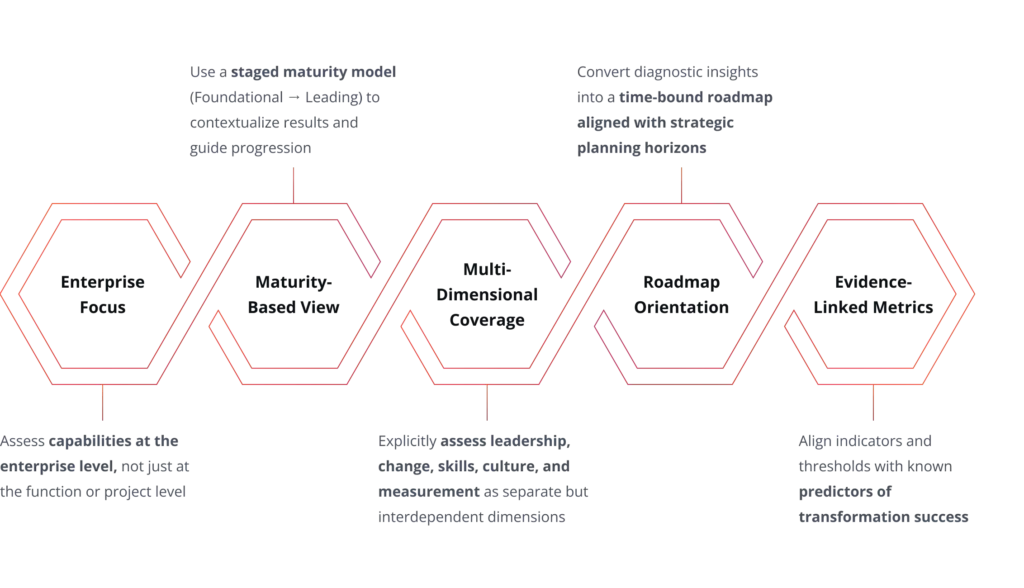
The toolkit is built on five principles drawn from these bodies of work:

4. The Workforce Readiness & Leadership Capability Maturity Model
4.1 The Five Dimensions
The toolkit evaluates workforce readiness across five validated dimensions, reflecting common constructs in HR, change, and learning maturity research.
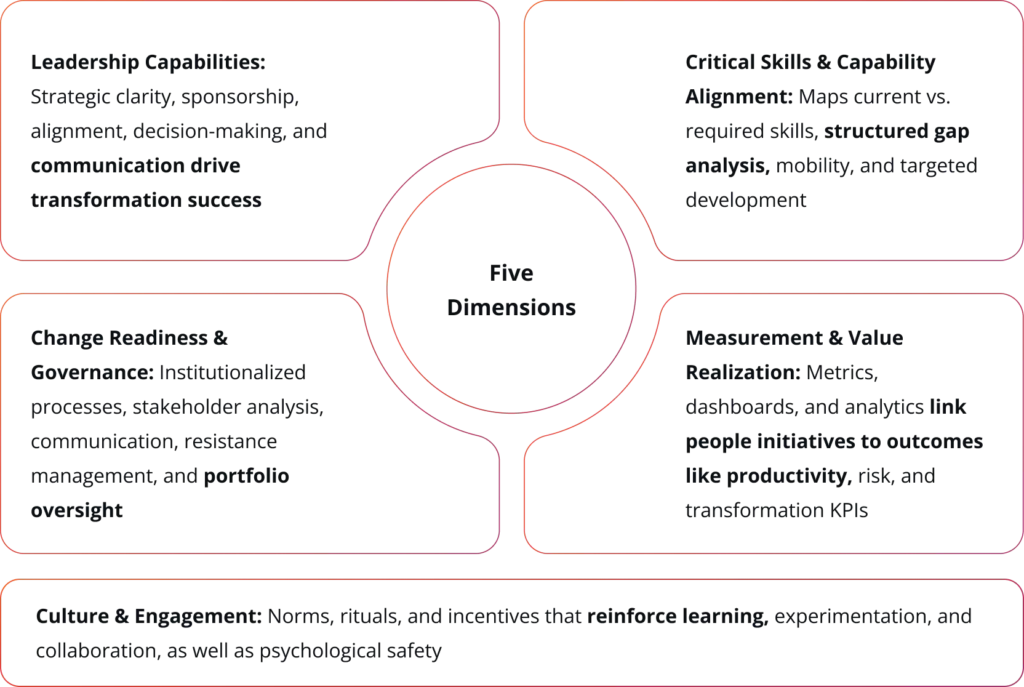
Each dimension is scored out of 25 and rolled into an overall 0–100 maturity index.
4.2 Maturity Levels
The model uses four levels, consistent with common HR and change maturity frameworks:
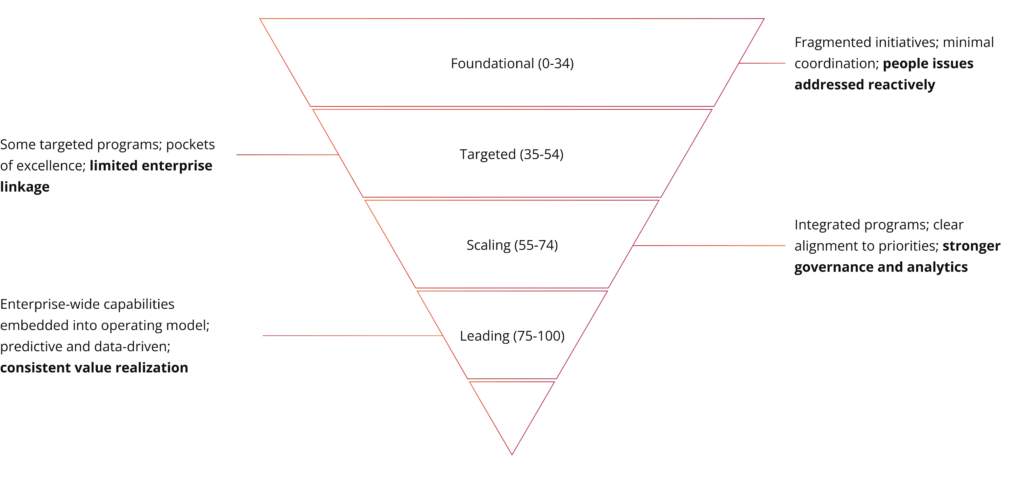
Each dimension has descriptors for all four levels, allowing both quantitative scoring and qualitative interpretation.
5. Toolkit Structure & Components
5.1 – Assessment Instrument (25 Questions)
The core instrument is a 25-item survey (5 per dimension) using a 5-point frequency scale (0 = Never, 4 = Always), designed to be completed in approximately 8–10 minutes. Items are phrased behaviourally, for example:
| Category | Description | Score |
|---|---|---|
| Leadership | Senior leaders consistently articulate a clear ‘North Star’ for transformation and link it to workforce implications | |
| Change | Major initiatives incorporate structured change management with defined roles, plans, and adoption metrics | |
| Skill | Leaders track current and emerging skills across roles or segments to inform build, buy, or borrow talent strategies | |
| Culture | Leaders model a culture of experimentation and continuous learning through their day-to-day actions | |
| Measurement | Leaders demonstrate the impact of capability investments on key business metrics (e.g., productivity, revenue, risk) |
5.2 Scoring Engine & Dashboards
An automated scoring engine (e.g., Excel or BI-based) computes:
- Overall maturity score (0–100)
- Dimension scores (0–25 each)
- Maturity level classification per dimension and overall
- Heatmaps highlighting strongest and weakest dimensions and items
This mirrors approaches such as the digital readiness scan, which generates both individual and aggregate views to support targeted interventions.
5.3 Outputs & Artefacts
The toolkit includes seven deliverables ready for stakeholder use:
- Assessment Form: Digital and printable versions
- Scoring Workbook: Automated calculations and visualizations
- Maturity Profile Report: PDF report summarizing scores, maturity levels, and qualitative insights
- Priority Roadmap One-Pager: High-level recommendations and focus areas over 12 months
- 12-Month Implementation Timeline: Phased workplan aligning with strategic cycles
- Executive Presentation Deck: Slide pack for C-suite and board discussions
- Case Snapshots: Anonymized examples showing how different maturity profiles translated into interventions and outcomes
Mini-Case Example:
A “targeted” financial services firm (scoring 48/100 on readiness) faced fragmented leadership priorities and unclear skill expectations across teams. By driving leadership alignment and developing a unified skills taxonomy, the firm achieved a 25% faster adoption of new programs and a 15% productivity lift within the first year.
6. Methodology: How The Diagnostic Is Conducted
6.1 Participant Selection
Designed for multi-stakeholder input, the toolkit engages 3–10 leaders across HR/L&D, business, transformation, and finance. Larger enterprises may also involve technology, operations, or regional teams to support cross-segment analysis.
6.2 Data Collection Process
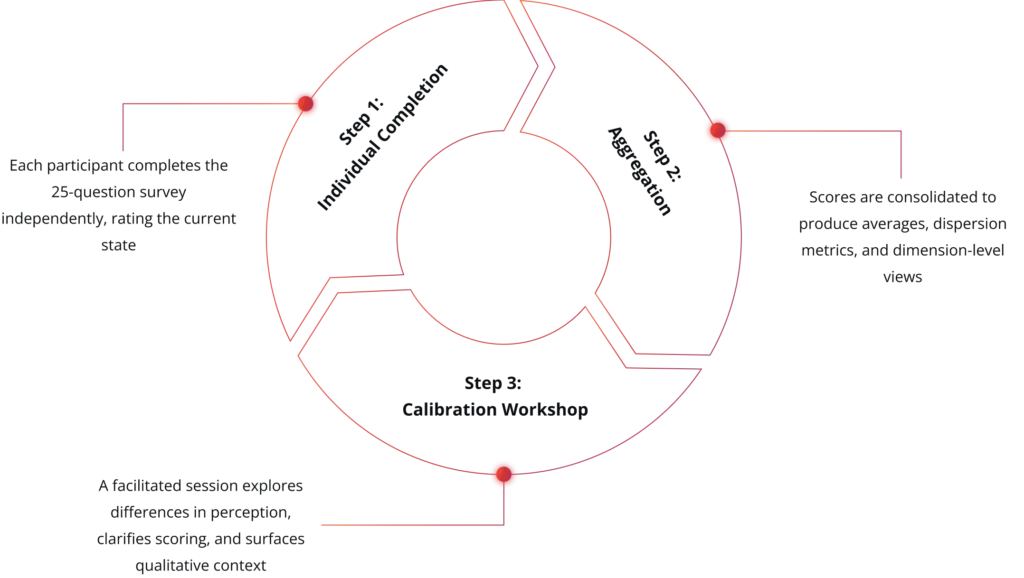
This combination mirrors practices in maturity assessments where both quantitative and qualitative data inform the final interpretation.
6.3 Scoring & Maturity Classification
Scores are computed as follows:
- Dimension score = Sum of 5 items (0–20 or 0–25, depending on scaling choice)
- Overall maturity index = Normalized average to a 0–100 scale, with thresholds mapped to the four maturity levels
Score bands (example):
- 0–34: Foundational
- 35–54: Targeted
- 55–74: Scaling
- 75–100: Leading

7. Interpretation Framework
7.1 Dimension-Level Interpretation
For each dimension, narrative descriptors explain what the score means in terms of behaviours, systems, and risks:
| Category | Score & Level | Description |
|---|---|---|
| Leadership | 12/25 – Targeted | Core leaders are supportive but inconsistent; narrative “North Star” exists but is not systematically linked to workforce plans; limited time spent actively guiding transformation |
| Change | 9/25 – Foundational | Change management is ad-hoc, often limited to communications; no enterprise methodology or portfolio view; risks of low adoption and change fatigue |
| Skills | 14/25 – Targeted | Some skills mapping and programs exist, but no integrated capability taxonomy; development plans are reactive; external hiring used heavily to close gaps |
| Culture | 18/25 – Scaling | Strong pockets of learning and collaboration; emerging rituals that support transformation; inconsistencies across regions or units |
| Measurement | 7/25 Foundational | Limited linkage between people initiatives and business outcomes; reliance on activity metrics; no integrated workforce dashboard |
7.2 Risk & Opportunity Assessment
The toolkit guides interpretation in terms of:
- Execution Risk: Where low maturity intersects with high strategic dependence (e.g., a digital transformation with low digital skills maturity)
- Value Upside: Areas where modest capability investments could unlock disproportionate performance gains (e.g., moving from Targeted to Scaling in measurement)
- Sequencing Dependencies: Recognizing that some dimensions (e.g., leadership and change governance) are preconditions for others (e.g., complex skills programs)

8. From Diagnostic To Roadmap
8.1 Prioritization Logic
The toolkit includes a prioritization matrix that:
- Ranks dimensions by maturity score and strategic criticality
- Groups interventions into short-term (0–3 months), medium-term (3–12 months), and long-term (12–24 months) horizons
- Maps typical consulting or internal initiatives to each dimension, such as leadership capability development, enterprise change management build, skills taxonomy and gap analysis, culture activation programs, or workforce analytics
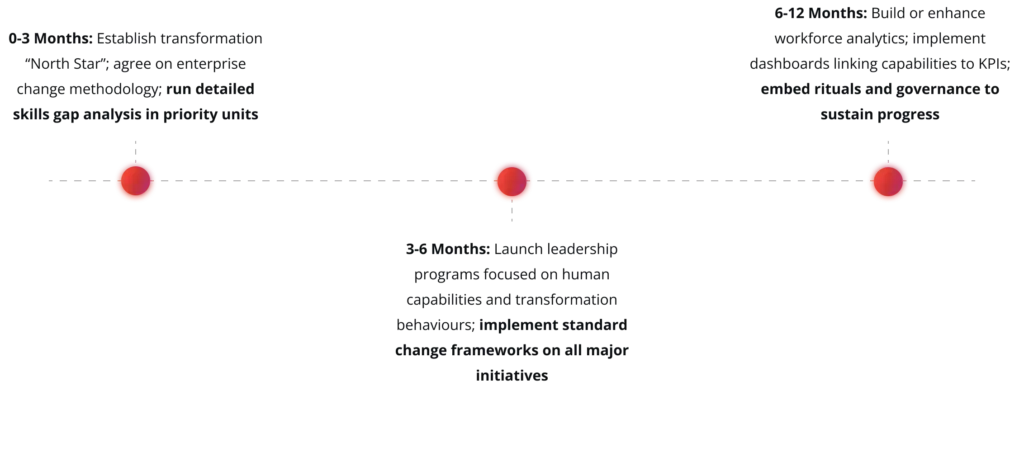
8.2 Example 12-Month Roadmap
For a representative organization with a score of 48/100 (Targeted), the roadmap might include:

9. Use Cases & Governance
9.1 When To Use The Toolkit
Typical use cases include:
- Pre-transformation planning for large digital, operational, or regulatory programs
- Post-merger integration to align leadership, culture, and capabilities
- Annual strategic workforce planning cycles and L&D portfolio reviews
- Board or C-suite reviews of transformation risk and readiness
9.2 Governance & Refresh
Best practice is to treat the diagnostic as a recurring management tool rather than a one-time survey:
- Frequency: Annual enterprise run; jointly owned by HR/Transformation/Business; integrated with existing PCMM, leadership models, change playbooks for extensibility
- Ownership: Jointly owned by HR/L&D, Transformation/PMO, and business leadership
- Integration: Linked to strategy reviews, capital allocation, and portfolio governance to ensure capability considerations are embedded in decision making

10. Implementation Support
The toolkit can be deployed in different modes:
Self-administered With Guided Resources: For organizations with in-house OD, L&D, or transformation capability that prefer to run the assessment internally using our structured playbook and support materials.
Facilitated By Wordsburg: For organizations that value an independent perspective, comparative benchmarking, and co-created transformation roadmaps informed by external best practices and reference cases.
Support typically includes:
- Orientation sessions for core sponsors and key participants
- Facilitation of calibration and results interpretation workshops
- Co-development of a 12–24 month transformation roadmap
- Optional design and delivery of targeted interventions such as leadership development, change management capability building, or skills taxonomy and gap analysis
11. CEO Readout
Three questions every board should ask:
- What’s our workforce maturity profile across the five dimensions?
- Where do low-maturity areas intersect with highest strategic risks?
- What’s our 12-month plan to close the top two gaps?
12. What This Toolkit Delivers
Aligned with research-based practices from major advisory and academic institutions, the Workforce Readiness & Leadership Capability Diagnostic Toolkit delivers:
- A concise, scalable assessment of workforce readiness across five critical dimensions
- A maturity model and scoring approach consistent with leading HR, change, and learning frameworks
- A structured method for translating diagnostic insights into prioritized, time-bound roadmaps
- Artefacts and processes that support board-level, C-suite, and functional decision making
13. Conclusion
The toolkit provides an integrated, evidence-based way to assess workforce readiness across five critical dimensions and convert fragmented insights into a single, quantified maturity narrative. By combining a concise survey, robust scoring, and structured interpretation, it helps leaders see where people, skills, and culture enable—or constrain—strategic execution. Used systematically (cost: <1% of typical transformation budget), it de-risks programs and accelerates value realization.

Ready to turn insight into action? To access the complete toolkit, connect with us now and explore how CHROs and business leaders apply transformation diagnostics and readiness lenses to strengthen strategic planning and portfolio reviews—then determine the best-fit approach for self-administered or facilitated deployment.
Recommended
Explore our transformation playbook turning training into a strategic growth engine. Grounded in global best practices, it shows how enterprises cut costs by 75%, boost productivity 32%, and deliver business results in 90 days.
Access CFO-ready insights, 90-day pilot roadmaps, and hybrid learning blueprints proven to deliver 353% ROI and 38% higher adoption.